

CuGo V4 implementation example [Bridge inspection robot_Gibir Research & Design Co., Ltd.]
Gibil Research & Design Co., Ltd., which handles design and inspection work related to the development and maintenance of social infrastructure such as roads and bridges. There are many sites with rough terrain, so we installed CuGoV4 to further update our inspection equipment. We spoke in detail about the background behind its introduction and how it is actually used in the field.
The person I spoke to
Planning and Development Office Manager Shigekatsu Minamide Planning and Development Office Deputy Manager/In charge of development, design, and marketing Yoshikazu Yokota (Title omitted in interview)
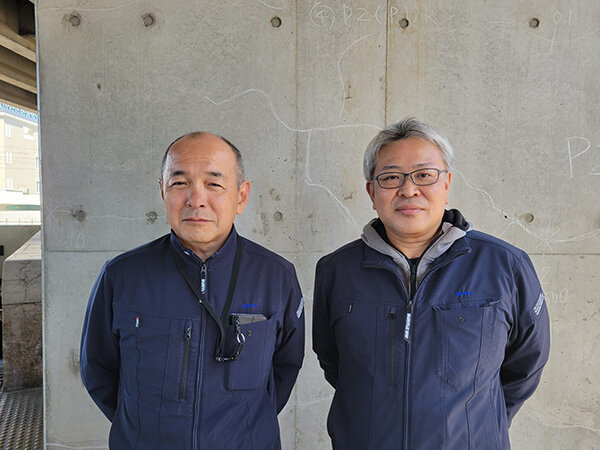
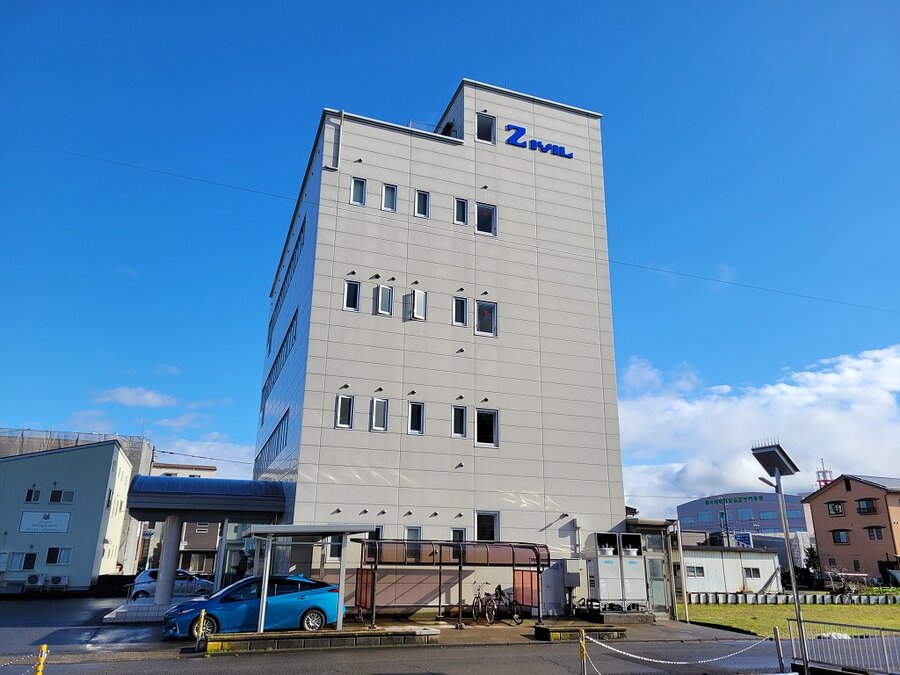
First, please tell us about your company's business and services.
Minamide : As a construction consultant, we are a company that primarily conducts inspection surveys and designs for public structures, such as roads, bridges, and tunnels.
Particularly in recent years, as public structures have become increasingly obsolete, the number of inspections and surveys has increased significantly as part of countermeasures. Our company has been developing various technologies for conducting inspections and surveys for about 10 years.
Please tell us more about the bridge inspection robot that you introduced our product to.
Minamide : After inspecting aging bridges, there is a need to carry out repair work to repair them. Normally, we take photos of the area and use the data to understand the situation, but when the site is small, it is difficult for people to enter and take photos, which creates the problem of not being able to accurately grasp the situation.
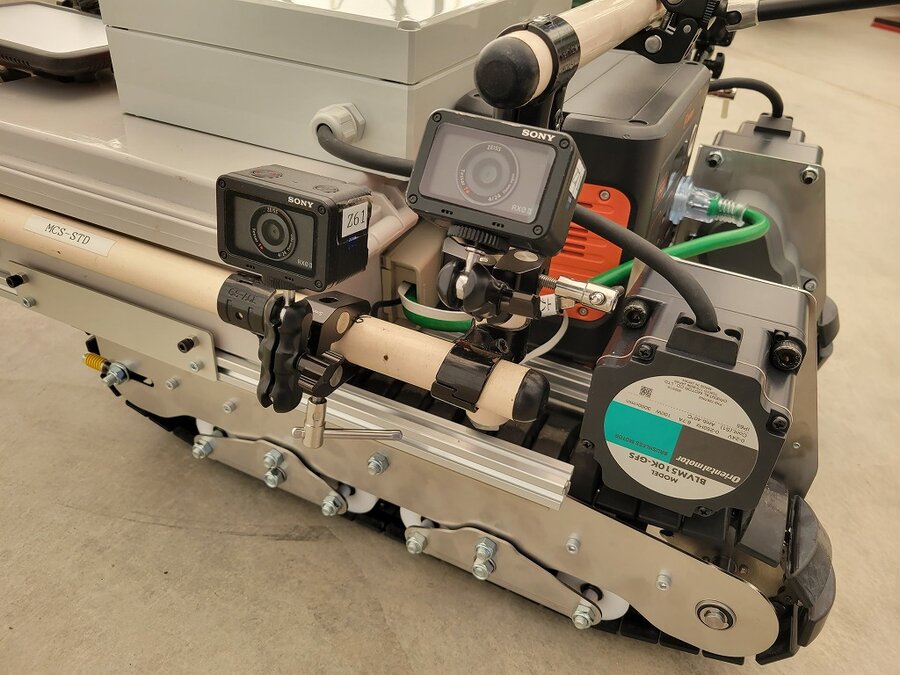
Therefore, we used CuboRex's CuGo V4, which can be used on rough terrain, to create a model of our multi-camera system "MCS" that can be used on rough terrain and in narrow spaces.
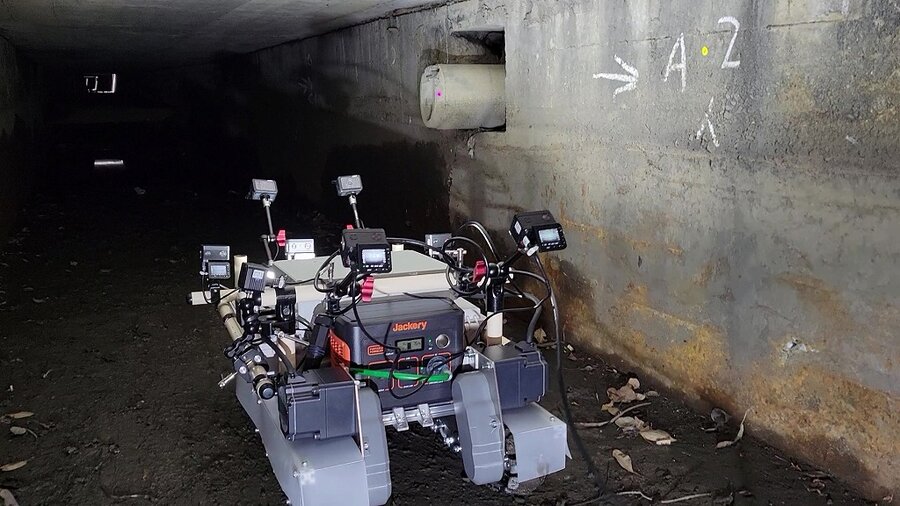
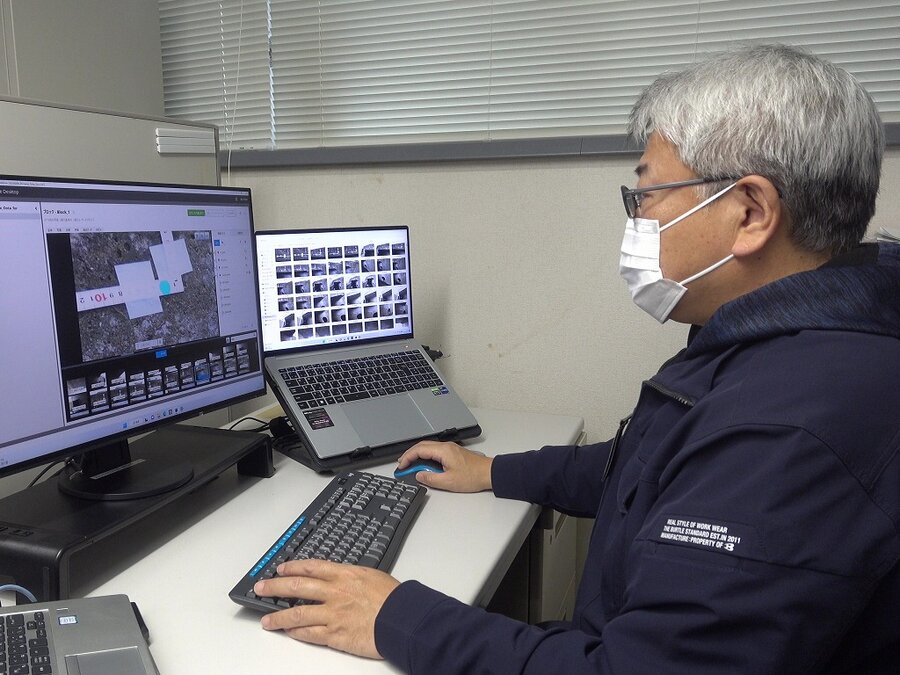
We use remote control to enter sites where it is difficult for humans to work, such as under bridge girders or narrow waterways, and create 3D models based on images taken with multiple cameras to assess various damage conditions at the site. This robot creates data that can be checked accurately and in detail from various angles.
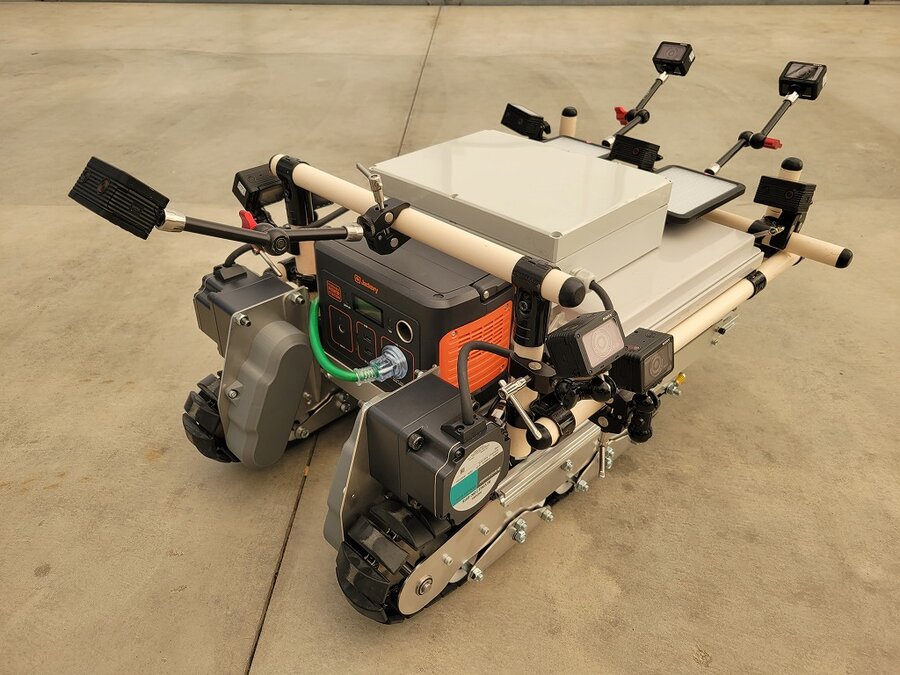
Multi-camera system CuGo model
Please tell us about the challenges and impetus that led to the introduction of this product.
Minamide : The inspection site under the bridge girder was a very difficult situation because people had to enter the very narrow space to carry out the inspection work.
Before the introduction, inspections were conducted in a narrow space, and people had to crawl to enter, but when the height was about 60 to 70 centimeters, they had to do their best just to get in to perform the inspection. There are many places where this is not possible. I really wanted to look up, but I couldn't look up, and I often ended up just crawling forward.
Therefore, we used a trolley similar to those used for automobile inspections, and a person rode on the trolley on his back to carry out the inspection. Due to the extremely poor working environment, we had to reconsider our methods, but we had not been able to consider specifically what to use or how to do it.
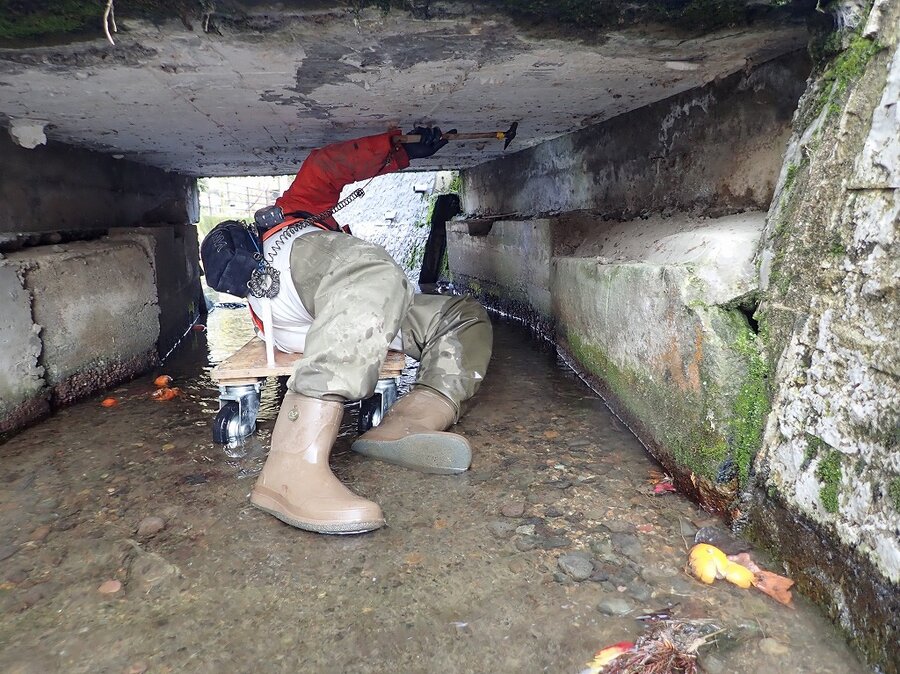
Inspection survey before introducing CuGoMCS
Meanwhile, I happened to pass by their booth at the 2022 Summer Exhibition, which I was participating in to gather information, and that's how I learned about CuGo.
I didn't know anything about crawler units, but I just happened to come across one and thought it was nice and could be used right away. At that time, V4 had not yet been released, and the V3 was on display there, but after that, I visited the CuboRex office and was introduced to V4, and I immediately decided to install it.
It felt really fast after it was introduced. I saw the product in July and purchased it, and the inspection robot was completed in October. I was able to use it for work within the same fiscal year, so the speedy process from development to on-site implementation was really helpful.
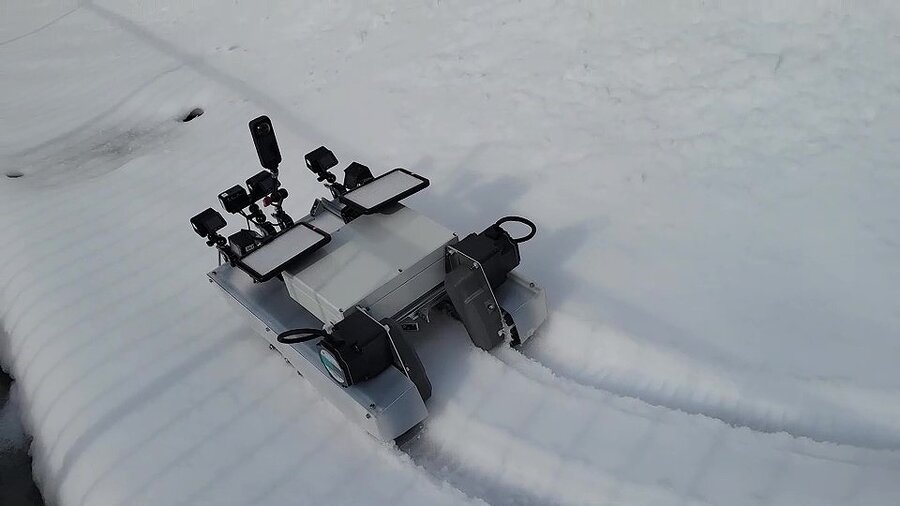
Gibil Research & Design has an office in the snowy country of Fukui Prefecture. Moving on snow is easy with a crawler.
Have you considered other companies' suspension systems?
Minamide : I had done some research on tire-shaped suspensions and other things, but I hadn't gotten to the point where I was thinking about specifically introducing one. After all, seeing the actual machine is the best because it gives you a better idea and is more persuasive.
Therefore, I did not compare it with other companies' products. When I saw CuGo at an exhibition, I knew it was the one.
What was the reason for choosing V4 over the cheaper V3?
Yokota : From a design standpoint, the first thing we didn't want to do was change the size of the MCS device itself, which was mounted on top of CuGo.
The V3 is a bit lacking in size, and since it will be used around water, the V4 has improved specs such as waterproof performance and reaction force, so it is more suitable for commercialization. I felt it was excellent considering the cost.
The running speed of the V3 is faster, but accuracy is more important than speed in our inspections, so we focused on torque rather than speed.
Minamide : From a practical standpoint, the main reason was that the compact size was extremely suitable for the site we wanted to inspect. Since it is powered by crawlers, it is also very attractive because it can overcome dirt and uneven ground. I also had high expectations for its durability.
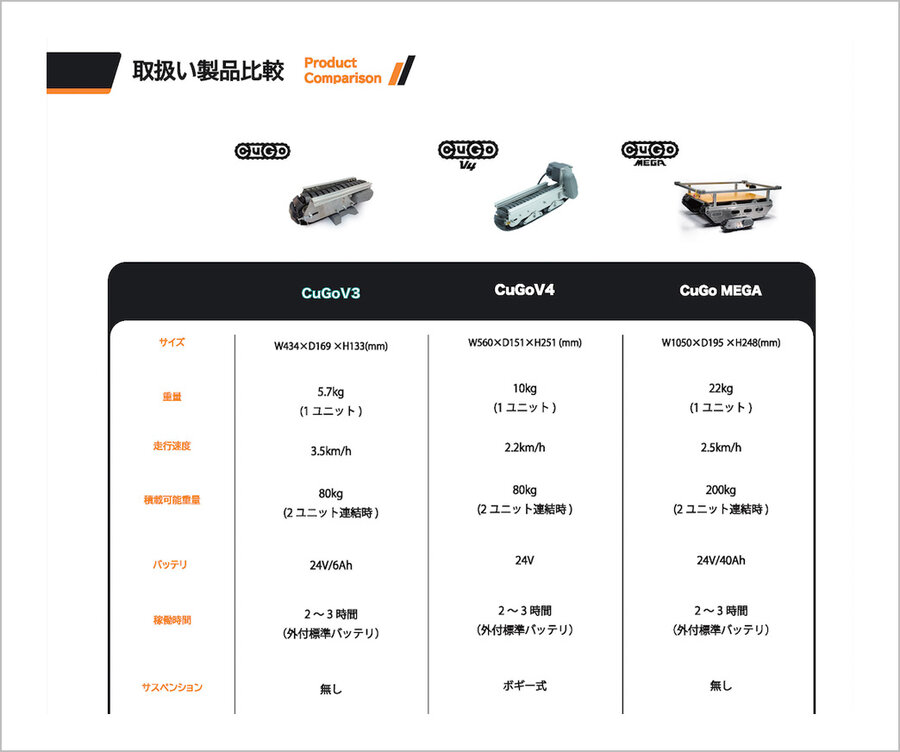
CuGo series spec comparison table
Click here for details on CuGo V4
Are there any benefits you gained by introducing V4 that you felt could not be achieved with other companies' products?
Yokota : I guess it's because of its high versatility. In contrast to those that are driven by crawlers, the main body is designed using MISUMI's aluminum frame. In that case, the biggest advantage is that it can be easily attached to any device by simply connecting it to the frame. It's very easy on the design side. We are currently using a device called MCS, and since it is easy to combine, it is very easy to apply it to other products. It is also possible to try it out once with other devices. I think this is a great strength.
Are there any disadvantages that you have discovered by introducing it, or any improvements you would like to see in the future?
Yokota : Well, I think there will be more variations and the development of larger models in the future, but since inspection surveys are often used near water such as canals, I would like to see further improvements in water resistance. I'm quite careful on the set, thinking, ``If it gets wet, it won't be good.'' It would be very helpful for the field side if there was something that was amphibious and had perfect water protection.
However, it is currently being used successfully in the field. There was one case where the chain came off when I ran it through a round clay pipe, but so far it's been running smoothly in outdoor fields such as snowy hills and muddy areas. I've been able to use it for a long time, so in that sense I'm generally satisfied.
In terms of what I hope for in the future, I think that the waterproofness will be improved, and that when inspecting round slopes such as clay pipes, if we can change the shape of the unit a little more, we will be able to expand the range of inspections. . Also, it would be nice to know how much power is left in the battery. Currently, there is no display of remaining amount.
What are the benefits and issues you feel have been solved by automating inspection and survey work?
Minamide : I feel that improving work efficiency and ensuring safety, which I mentioned earlier, are important. By automating inspection work that normally requires two people, it can now be done by just one person.
The quality of the resulting data has also improved. The improved shooting accuracy has also made it extremely effective for secondary use.
By automating inspection technology, what kind of future will Jibil Research & Design hope to realize for infrastructure facilities and the construction consulting industry?
Minamide : In the construction industry, on-site work is basically done by people, but the number of people is decreasing rapidly and there is a shortage of engineers, so in the future we will promote so-called DX and do various things. I would like to supplement this with new technology. Personally, I would like to accurately grasp the needs of the field from a technical perspective and utilize this in development. I hope that this MCS using CuGo will be one such example.
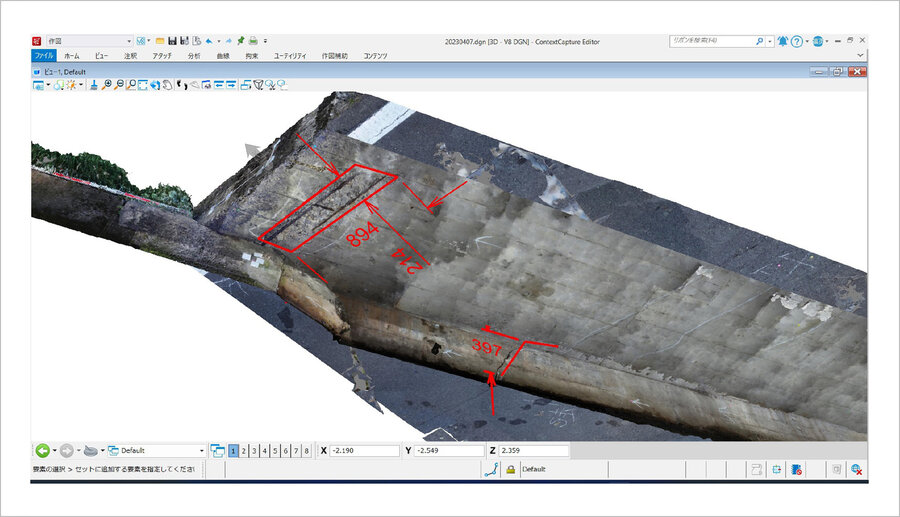
3D data image of a bridge. It is possible to clearly check and analyze the damage situation down to the smallest detail.
Yokota : I originally specialized in machinery, but I'm currently in my fourth year at Jibil Research & Design. The civil engineering industry is a bit behind in the field of DX, and is a conservative industry, so there are cases where new technology and equipment are actually frowned upon.
However, when thinking about how to improve efficiency, I believe that we must continue to try new things.
First of all, I look for the best concept that I can think of, rather than being useful or useless. I hope that by using products like CuGo and products from various companies that fit the bill, I can develop something that can help improve the profits of the industry as a whole. As an engineer, I would like to carry out my work with high ideals.
In fact, there are very few companies in the construction industry that use 3DCAD. When I first received the V4 data from CuboRex, I was a little impressed when it came in 3D data. LOL The design progressed smoothly, and the high level of compatibility with the engineers in the area may have been a contributing factor to its introduction.
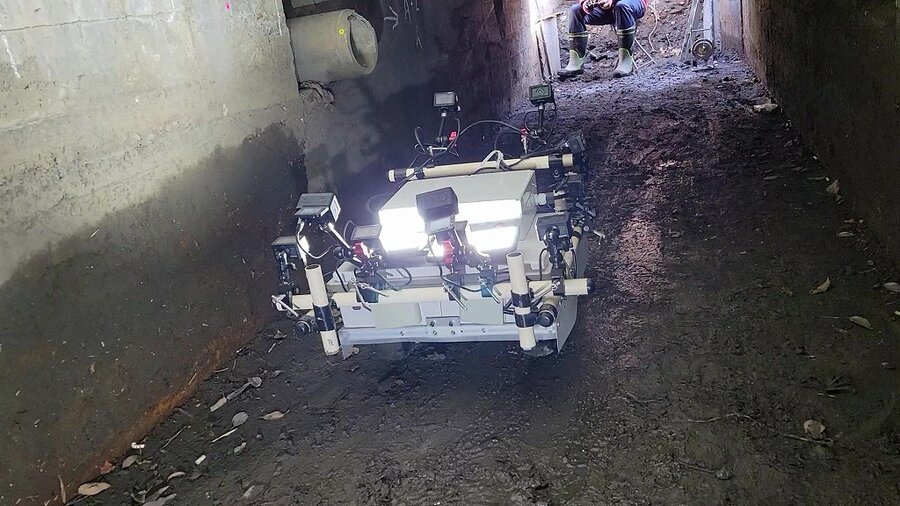
Our product is also a device that allows customers to see in 3D the on-site conditions that are difficult for people to visually inspect and help them understand them more quickly.
CuGo has the same concept as MCS, which is to reduce the burden on sites where it is difficult for people to enter, and to improve work efficiency and accuracy.
By using CuGo, our MCS is now able to more accurately inspect narrow sites where it is difficult for people to enter. It was truly a coincidence at an exhibition, but I think it turned out to be a very successful case.
-------------------------------------------------- --------------------------